Corporate Photo Booth Activations: What Brands Want Now
Key Takeaways Brands are moving marketing budget into in-person events because trust in social media, paid ads and search is slipping. Photo booths already show up at a huge share of corporate activations, and they still often get booked last, with leftover budget. Clever staging matters more than a big budget. The activations people remember put the guest inside the brand's world. The strongest booths create connection between attendees, and analog pieces like prints, cards and mail are pulling a lot of that weight. Pitch the booth as an engagement piece with reporting behind it, and leave the "this will be your marketing" promise out of the room. Differentiate your offer or you'll end up competing on price.
Our industry has a habit of listening to the same speakers over and over again. So when we were planning Illuminate, I wanted one person on that stage who doesn't sell photo booths and sees them from the planner's side of the table.
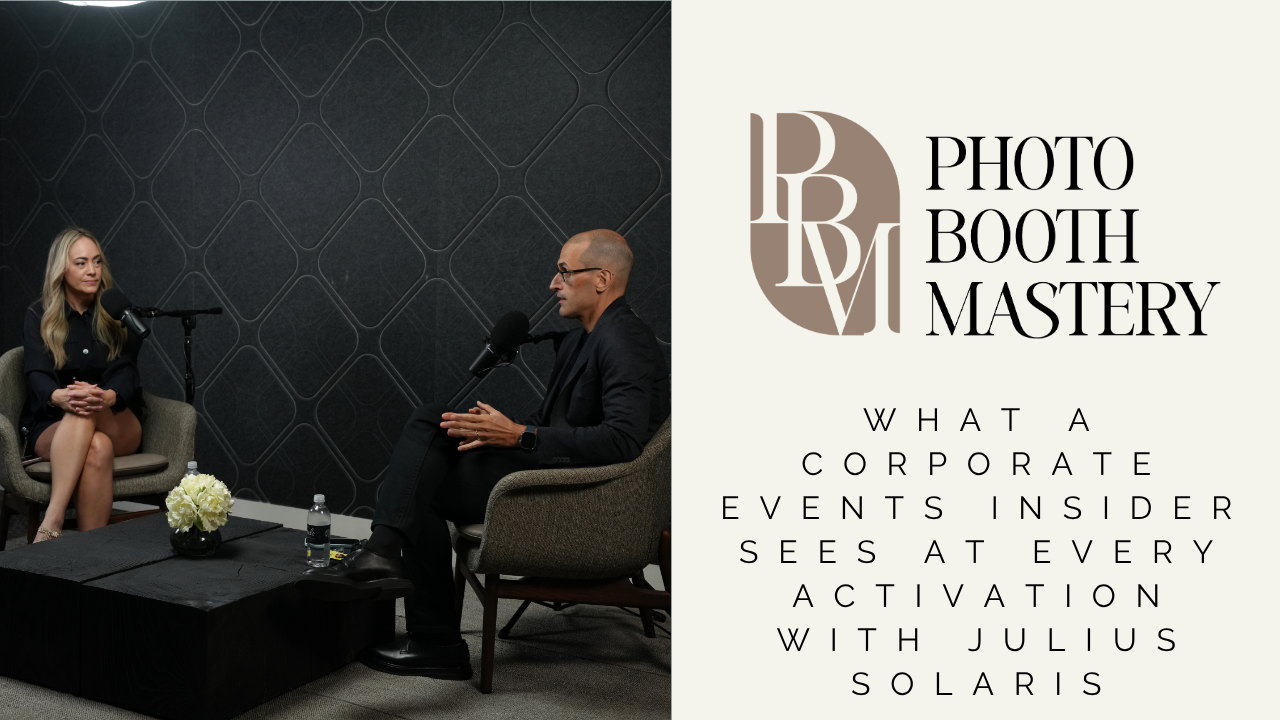
That person was Julius Solaris. The day before his keynote in Miami, I sat down with him for Scaling Out Loud to talk about corporate photo booth activations: what he's seeing at the biggest events in the world, why brands are putting so much money into in-person experiences right now, and why so many photo booths still get treated like an afterthought.
If you're a photo booth founder trying to grow your corporate side, this is a look at how the people who hire you think. We get into the shift in marketing budgets, what makes an activation stick even when the budget is small, the Dreamforce activation Julius keeps bringing up, and his one piece of advice for anyone who doesn't want to end up in a race to the bottom on price.
Prefer to watch? [CTA: Watch this episode on YouTube: https://www.youtube.com/watch?v=MPM3dAhOeMU]
[IMAGE: Catalina Bloch and Julius Solaris recording Scaling Out Loud at Illuminate in Miami | Alt text: Julius Solaris talking about corporate photo booth activations on the Scaling Out Loud podcast]
Who Julius Solaris Is and Why I Wanted Him at Illuminate
Julius consults for Fortune 500 companies on their event strategy, mostly tech companies with large audiences, on everything from sponsorship and registration to overall event design. He's the founder of Boldpush, he writes a newsletter that goes out to 40,000 event planners, and he's been covering the events industry from a media seat for 20 years. His previous business was acquired by Skift.
He's based in Vegas, he's Italian originally, and he describes himself as an event Karen. He goes to events to analyze them for his clients and does breakdowns and teardowns of large events, so he notices everything. Recent events he's covered include CES, Cannes Lions, Dreamforce in San Francisco (around 50,000 people) and the FIFA World Cup.
I've followed his LinkedIn content for a long time because it doesn't read like the corporate jumble you usually get. His lists of things to stop doing were so helpful while we were building Illuminate. If you're a photo booth founder and you don't follow him yet, go find him on LinkedIn and sign up for his newsletter.
[INTERNAL LINK: Illuminate Update: Meet Our Keynote Speaker (EP 31) | blog post + YouTube: [EP 31 YouTube link; ONLY if not on YouTube use the EP 31 audio page from https://photoboothmastery.catalinabloch.com/podcasts/scaling-out-loud]]
Why Brands Are Moving Marketing Money Into In-Person Events
Julius's first point is the one I'd want every corporate-focused founder to understand. Traditional marketing is moving toward in-person experiences, and he said it's having a huge effect on the business events industry.
Trust Is Slipping Everywhere Else
Think about the marketing tools brands have right now. Julius pointed to trust being lost on social media, on traditional pay-per-click advertising, and on SEO, which AI has turned upside down. Companies are scrambling their plans and looking for new ways to reach decision makers.
Whether it's B2B or B2C doesn't really matter, he said. Brands are investing in events now because events are effective.
One Event Covers a Big Chunk of the Buying Journey
Julius's team did research and counted around 75 touch points before someone makes a purchase decision in business-to-business. [FACT CHECK NEEDED: source and publication for Julius's touch point research]
An event can pull together 10 to 15 of those touch points in one place, from registration to the in-person experience to the follow-up to the social media created around it. With that many touches happening inside one event, the decision-making process gets shorter. That's why marketing teams and brands are thinking about events like never before.
[CALLOUT] An event can cover 10 to 15 of the roughly 75 touch points in a B2B buying decision, according to Julius's research.
The Money Is Following
How does he know this shift is real? He pointed to around $10 billion worth of acquisitions of event companies in the past seven months. [FACT CHECK NEEDED: verify the $10 billion figure and time frame] Event companies are getting richer because marketing teams are spending more on events, and private equity has started investing in them.
In 20 years of covering the industry, Julius said he's never seen this much anticipation, excitement and investment flowing into events.
What This Means for Your Photo Booth Business
This is exactly why I wanted to have this conversation. I don't think our industry understands how big the corporate event world is, or how many niches inside it a photo booth could show up in. When marketing budgets move into events, the activations at those events are where a lot of that money gets spent.
[INTERNAL LINK: Weddings Fund It. Corporate Grows It. (EP 36) | blog post + YouTube: [EP 36 YouTube link; ONLY if not on YouTube use the EP 36 audio page]]
Photo Booths Are Already Part of Almost Every Activation
Julius said the photo booth presence he's seeing everywhere is incredible. At nearly every event he goes to, South by Southwest included, a huge percentage of activations involve some kind of photography. That ranges from large builds with scenography and design to quick get-your-picture setups.
His reason is simple. People want memories, and a lot of the time they want tangible memories they can bring home.
He also said the fact that we're putting on an event specifically for photo booth providers shows how much our industry has grown and specialized. Smaller communities like ours need to get together to understand what's going on.
[IMAGE: Branded photo activation at a large corporate conference | Alt text: Corporate photo booth activation with custom staging at a trade show]
What Makes Corporate Photo Booth Activations Memorable
I asked Julius which photo and video activations have stuck with him, and why.
Staging Matters More Than Budget
He loves appropriate staging around the photo experience, and he was clear that it doesn't have to be monumental. When he shows examples in his presentations, he sees faces in the audience that say "I don't have the budget, how am I going to do it?"
His take is that the budget card is a great excuse not to be creative. With real creativity, and especially with video, you can pull together a great experience without an incredible setup.
[CALLOUT] "The budget card is a great excuse not to be creative." (Julius Solaris)
Inside the Paramount+ House at South by Southwest
One of his favorites is the Paramount+ house at South by Southwest in Austin. Last year he was dressed as a Roman, Julius Caesar style, voting thumbs up or thumbs down on the gladiator, and they created a full video of him in costume on a full stage. Another experience wrapped guests up Dexter style, the way the bodies get wrapped in the show.
Those were consumer experiences with a line to get in, and the staging was so well done that everybody wanted to share it on social media.
Events Are Becoming Stages for Our Online Personas
Julius put it bluntly: who's going to share a plain photo booth picture on social media anymore?
We need more than a picture. He sees events becoming stages for our online personas, which means relying on your ability to build a whole environment around the guest. He comes from Vegas, where venues like Area15 have incredible staging so you feel like you're in a different world while you take your memories.
Why the Logo-on-a-Photo Pitch Falls Flat
This is where I jumped in, because I see it constantly. A lot of photo booth companies think you slap a logo on a photo, put it in a trade show booth, and people will be attracted to it. Nobody really wants to take home a photo of themselves with a logo on it. They're not putting that on their fridge.
When the photo is built into the experience and becomes part of it without pulling the guest out of it, that's where it works. People want to share it because it feels cool. And our machines can do so much more than a camera and a printer, whether it's video, a photo, or a lanyard someone picks up at the registration desk. Teaching people to build the experience is one of the things we focus on most.
[INTERNAL LINK: Stop Calling It an Activation (EP 16) | blog post + YouTube: [EP 16 YouTube link; ONLY if not on YouTube use the EP 16 audio page]]
Why Photo Booths Still Get Treated as an Afterthought
I asked Julius straight out: have photo booths traditionally been an afterthought in event planning? Some budget left over, let's throw a booth in there?
Branded, and Completely Detached
He told me about walking around New York City before coming to Miami and finding photo booths on Broadway, sitting in a square as an activation. They were incredibly branded and just randomly there.
He sees the same thing at events, where attention should be high and the booth should be front and center and on brand. Instead it's detached, set out with a catchy phrase on it. His question was whether that's enough anymore.
We're several years into strong post-pandemic traction for photo booths, he said, and with AI giving booths a big injection of what they can do, the sky's the limit. But if the booth doesn't fit the scenario, people feel deflated. They stop feeling part of it, and they move on and grab the free coffee instead.
The Real Reason the Tech Gets Booked Last
Julius sees photo booths as part of the technology side of events, and the tech piece unfortunately gets left to the last minute. He doesn't blame short-term thinking from planners. Event professionals are working in a really complex cost environment, with venues and food and beverage hammering their budgets.
He understands that to a point. But if a brand is already spending money to exhibit at a show or be present at a user conference, he said, you have to make an effort. Showing up halfway, or remembering the activation at the last second, won't perform, and it wastes the little money you had.
[CALLOUT] If a brand is already paying to exhibit, a last-minute activation won't perform. It just wastes what's left of the budget.
What Corporate Clients Don't Know a Photo Booth Can Do
I added something here that I think gets lost with a lot of corporations. Photo booths seem new, but the photo booth itself celebrated its 100th anniversary in 2025. [FACT CHECK NEEDED: confirm 1925 origin date for linking] They became more mainstream around 2010, when you started seeing them at weddings. During the pandemic we went virtual and built our entire business on a virtual photo booth, and when events came back, the industry exploded.
What a lot of clients still don't see is that a photo booth is a marketing machine on the back end too. We can collect emails that go into an email list for follow-ups. If a brand wants to grow its list, guests can type in their email address and opt in to the mailing list.
Every photo booth founder I know has struggled to teach corporate planners and agencies how much a booth can actually do. So when Julius told me the first time we talked that he sees photo booths everywhere, it signaled to me that we're finally getting to the point where booths become part of the initial plan.
[TABLE/GRAPHIC OPPORTUNITY: "What the client sees vs. what the booth collects" two-column graphic: photo, video, prints on one side; email opt-ins, time spent, downloads, shares on the other]
The Dreamforce Photo Booth Activation Julius Can't Stop Talking About
This was the example I was most excited to hear him explain.
Basic Equipment, Smart Follow-Through
The setup itself was simple. Julius described it as pretty rundown by our standards: basic iPads spread around a table where you type in your info and take a picture, shot from below, which he called the worst kind of picture you can take.
What they did with it is what made it work. First the photo became an AI avatar, which plenty of activations do. Then attendees answered a few questions about how comfortable they were with different Salesforce software, and the booth printed two cards with a QR code.
- One card went on your badge, so you could trade cards with other attendees.
- The other went on a map that showed attendees coming from all over the world.
[TABLE/GRAPHIC OPPORTUNITY: Dreamforce activation flow: iPad photo, AI avatar, software comfort questions, two printed cards (badge trading card + world map card)]
Connection Is the Reason People Show Up
Julius said connection is the number one driver for events today, more than content and more than entertainment. That one simple booth created two moments of connection: a card you could trade or use as an icebreaker, and a wall showing the reach of the event across the world.
The person who created that experience was in the room at Illuminate, which made me so happy. [FACT CHECK NEEDED: confirm full name and company of "Billy," the Dreamforce activation creator, before naming in the post]
He also pointed out that this took intention. Dreamforce has an entire community pavilion with breakouts, developer groups and impromptu networking areas, and not every event can do that. Compare it to the networking section of most event apps, where you're doom scrolling through 500 people hoping to connect with someone. He called that sad. We need analog tools like this to connect.
The Analog Side of Your Booth Matters Again
Julius was clear that he's not a photo booth expert. He's an expert in events, and from that seat, he sees printing, analog and sending as important right now.
At Cannes Lions, Google ran an activation where you could print straight from Nano Banana through a photo booth and send it as a postcard to your family. His family in Italy received it and reacted like they'd seen him for the first time in ages, even though they'd talked on the phone the day before. With Gen Z and the nostalgia moment going on, he sees those physical pieces as a big deal.
[IMAGE: Printed trading cards and postcards from a photo booth activation | Alt text: Printed photo booth trading cards used for attendee networking at a corporate event]
How to Build the Business Case for Corporate Photo Booth Activations
Look Past the Moment of the Picture
Julius said photo booth providers need to step up the conversation with event planners and build a business case that goes beyond the picture and the engagement in the moment. Moments come and go in the events industry. If you're in this for the long game and don't want to be a trend, start thinking past the moment of the picture.
That case doesn't have to be transactional. Capturing an email and turning it into product sales could happen out of a photo booth, he said, and the bigger piece is the type and quality of the interaction, and the quality of that touch point with the customer.
Report Back What Actually Happened
He wants providers to be able to report back to businesses: all these people were deeply engaged, they spent this much time, they downloaded, and the sharing of these images went through this many people. That turns the booth into an activity that covers the marketer's whole funnel and puts their brand in front of more eyeballs.
The logo, he said, was the beginning of the photo booth world, when we printed the logo and said our logo is going everywhere. What brands need now is an identity, and a partner in designing what the experience looks like, especially with what AI makes possible. He called it a creative consultancy, coming up with concepts that are incredible.
[INTERNAL LINK: Corporate Wants Something New. Do You Have It? (EP 37) | blog post + YouTube: [EP 37 YouTube link; ONLY if not on YouTube use the EP 37 audio page]]
Julius's Advice for Photo Booth Founders: Differentiate or Race to the Bottom
I closed by asking Julius for one piece of advice for the photo booth founders in the room and listening at home.
Product-Led Growth
If you're yet another photo booth company doing the same thing everybody's doing, he said, it becomes a race to the bottom. It turns into a pricing issue, or maybe a relationship issue, where everything depends on personal connections. Those connections are important, but if you're product-led, meaning your growth comes from the product and your approach to photo booths, you become unstoppable.
Build Your Offer Around AI, the Physical, and Connection
If you're spending time listening to a podcast like this or coming to a retreat, Julius said, you want an edge. The edge is asking how you're going to be really different, and how your offer uses AI, the physical part and the connection part. He sees those three as the biggest opportunities in our industry right now.
Up until three or four years ago, it was a flat picture. You could Polaroid it or give it an '80s feel, and that was that. Now there's endless opportunity with AI, and younger generations are hungry for collectibles like trading cards and nostalgia-driven artifacts.
[INTERNAL LINK: The Real Competitive Advantage in the Photo Booth Industry (EP 22) | blog post + YouTube: [EP 22 YouTube link; ONLY if not on YouTube use the EP 22 audio page]]
Become a Marketing Partner for Marketing Teams
His final piece: become a marketing partner for marketing teams. Don't walk in with a pitch that the photo booth is going to be the marketing, because it isn't. It's an important piece of engagement that leads to higher engagement and eventually to higher intent to connect with the brand.
Julius has worked with photo retrieval systems on the software side, and he's heard the claim that if someone takes a picture, they'll end up buying more and more. In this cost environment, that's a very hard conversation to have.
But if you can put together reports that are really effective, collect the impressions and social sharing that come out of a booth, and show a much better brand integration, that's a completely different conversation. You'll get attention because you're offering something unique, and marketing teams are desperate for new ideas that have a real business impact.
[CALLOUT] Marketing teams are desperate for new ideas with a business impact. Bring them engagement and the reporting to prove it.
Where to Start With Your Next Corporate Proposal
Pull up the last corporate proposal you sent and read it the way Julius would walk past your booth. Is the photo built into the client's experience, or is it sitting off to the side with a logo on it? And is there anything in there you could report back to their marketing team after the event?
If the answer to that second question is no, that's where I'd start.
[INTERNAL LINK: Five Ways I Use AI in My Business (EP 38) | blog post + YouTube: [EP 38 YouTube link; ONLY if not on YouTube use audio: https://photoboothmastery.catalinabloch.com/podcasts/scaling-out-loud/episodes/2149251035]]
Frequently Asked Questions About Corporate Photo Booth Activations
Why are brands spending more on in-person events?
Trust in social media, pay-per-click advertising and SEO is slipping, and AI has changed search. Events can cover 10 to 15 of the roughly 75 touch points in a B2B buying decision, which shortens the sales cycle, so marketing teams are moving budget into in-person experiences.
What makes a corporate photo booth activation memorable?
Staging that fits the event and puts the guest inside the brand's world. It doesn't need a huge budget. The activations people remember are built into the experience instead of sitting off to the side with a logo on the print.
Why do photo booths get booked last for corporate events?
Planners are working with tight budgets, and venues and food and beverage take a big share. The technology piece, including photo booths, tends to be left to the last minute, which is why the booth often ends up detached from the rest of the event.
What should I report to a corporate client after a photo booth activation?
Report how many people engaged, how much time they spent, what they downloaded, and how far shared images traveled, along with impressions and social sharing. That gives the marketing team something they can measure against their goals.
What was the Dreamforce photo booth activation?
Attendees took a photo on a basic iPad, it was turned into an AI avatar, and they answered a few questions about Salesforce software. The booth printed two cards with a QR code: one for the attendee's badge to trade with other attendees, and one for a world map showing where attendees had come from.
Should I pitch my photo booth as a marketing tool?
Pitch it as an engagement piece that leads to higher intent to connect with the brand, backed by reporting. Promising that a photo will directly drive sales is a hard conversation to win right now.
Who is Julius Solaris?
Julius Solaris is the founder of Boldpush. He consults for Fortune 500 companies on event strategy, writes a newsletter for 40,000 event planners, and has covered the events industry for 20 years. He was the keynote speaker at Illuminate 2026.
[SCHEMA: Mark up the FAQ section above with FAQPage schema (JSON-LD), one Question/acceptedAnswer pair per H4.]
Watch or Listen to the Full Episode
Julius says a lot more in the full conversation than I could fit here, and it's worth hearing him tell the gladiator story himself.
[CTA: Watch on YouTube: https://www.youtube.com/watch?v=MPM3dAhOeMU | Listen on Apple Podcasts: [Apple link] | Spotify: [Spotify link]]
Every episode of Scaling Out Loud is on my YouTube channel, so if you'd rather watch, subscribe here: https://www.youtube.com/@PhotoBoothMasteryCourse
Have a corporate activation you're proud of? DM me on Instagram at @photoboothmastery: https://www.instagram.com/photoboothmastery
And if you know a photo booth owner who's been trying to break into corporate, send them this post.
[CTA: Join the Photo Booth Mastery email list: [email opt-in link]]
Your Next Steps
- Work with Me: https://bit.ly/POD-Site2
- Join Thrive: https://photoboothmastery.catalinabloch.com/Thrive
- Connect on Social: https://www.instagram.com/photoboothmastery
SUBSCRIBE FOR ALL THE PHOTO BOOTH TIPS.
By subscribing to our newsletter, you consent to receive promotional emails, updates, and other marketing communications from our company. We respect your privacy and will never share your information with third parties without your consent. You may unsubscribe at any time by clicking the unsubscribe link in any email.